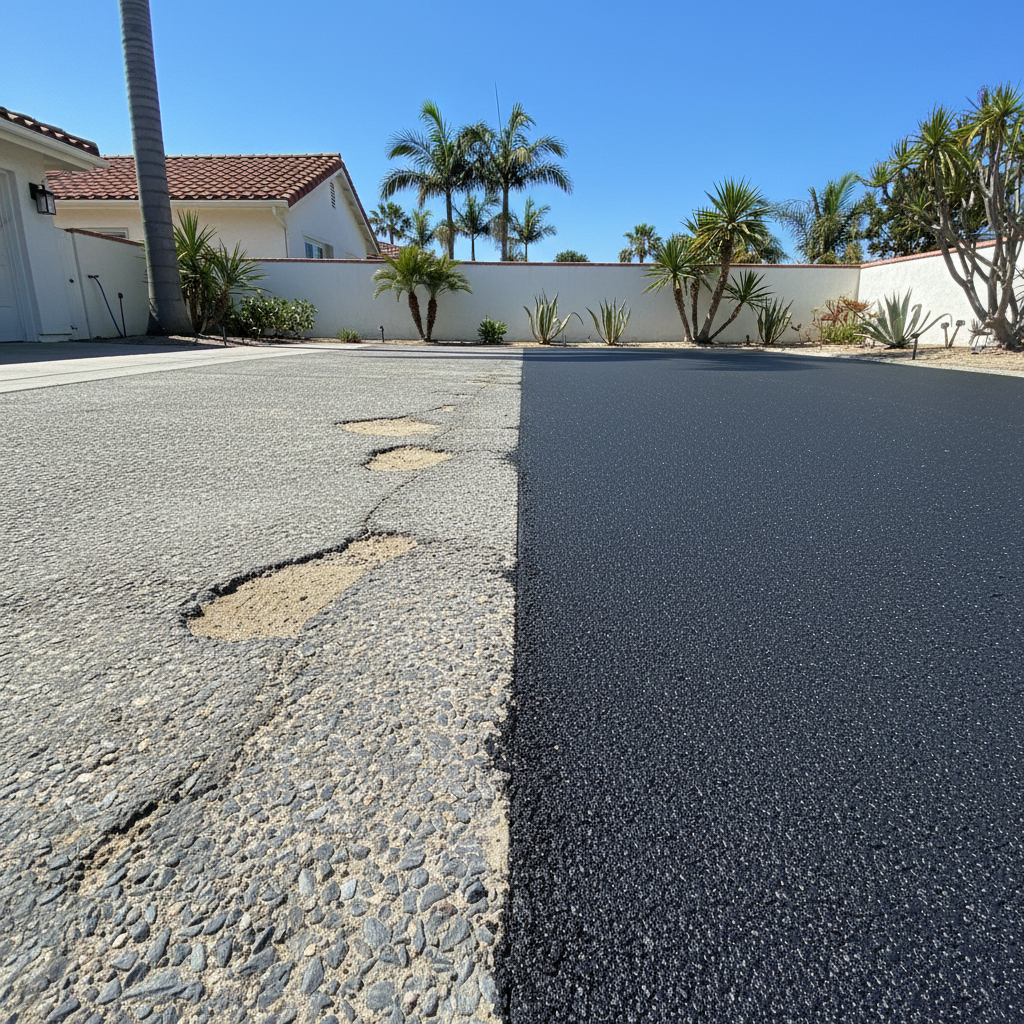
Alright, let's talk about asphalt milling. If your driveway's seen better days – maybe some nasty potholes, cracking, or just general wear and tear – you're probably weighing your options. Milling is a common solution, sure, but it's not a one-size-fits-all deal. You've generally got two main ways to approach it: a targeted cut-and-patch method, or a full surface grind. I see both of these used all over Newport Beach, from the tight streets of the Peninsula to the larger properties in Dover Shores, and honestly, each has its place.
Targeted Cut-and-Patch Milling: When Less is More
This approach is exactly what it sounds like. Instead of milling the entire surface, we're finding specific problem areas – think deep potholes, alligator cracking that's gone beyond simple sealing, or spots where the asphalt has started to heave. We'll mark these, then use a milling machine to cut out just those sections to a specific depth. Once that old, damaged asphalt is removed, we clean out the area, apply a tack coat, and then lay down fresh asphalt, compacting it to match the surrounding surface. Pretty straightforward, right?
The Good Stuff:
- Cost-Effective for Localized Damage: If your driveway is mostly in good shape but has a few really bad spots, this is usually going to be cheaper. You aren't paying for milling and new asphalt across the entire surface, which saves money.
- Faster Project Time: Less area to mill and pave means we're often in and out quicker. That's a big plus when you want your driveway back in action fast.
- Less Disruption: Since we're only working on specific sections, there's less overall mess and disruption to your property.
The Not-So-Good Stuff:
- Appearance: This is the biggest drawback. You're going to have patches. Even with a skilled crew like Valley Paving, you'll see where the new asphalt meets the old. It just won't be a uniform, seamless look.
- Limited Lifespan for Surrounding Areas: While the patched areas will be strong, the rest of your driveway is still the old stuff. If other areas are showing signs of age, they might fail sooner, leading to more patches down the road.
- Not for Widespread Deterioration: If more than, say, 25-30% of your driveway is shot, trying to patch it all becomes inefficient and, frankly, ugly.
Full Surface Grind Milling: A Fresh Start
This is the more comprehensive option. With a full surface grind, we're milling off a consistent layer of the entire asphalt surface. Typically, we're talking about removing 1 to 3 inches of the existing asphalt. This creates a clean, uniform base for a new asphalt overlay. It's like resetting the clock on your driveway's top layer, giving it a whole new lease on life.
The Good Stuff:
- Uniform Appearance: This is where it really shines. Once the new asphalt is laid, your driveway will look brand new, with a consistent color and texture across the entire surface. No patches, no seams.
- Improved Drainage: If your driveway has developed low spots or poor drainage over time (which can happen with our coastal humidity and occasional heavy rains leading to water pooling), milling the entire surface allows us to re-establish proper slopes and ensure water runs off correctly.
- Extended Lifespan: By removing a significant portion of the old, fatigued asphalt and replacing it, you're essentially getting a whole new wearing course. This significantly extends the life of your driveway compared to just patching it up.
- Addresses Underlying Issues (to a point): While it doesn't fix a completely failed sub-base, removing the top layer allows us to better assess and address minor base issues before paving.
The Not-So-Good Stuff:
- Higher Cost: More material removed and replaced means higher labor and material costs. There's no way around that.
- Longer Project Time: Milling and paving an entire driveway takes more time than just patching a few spots.
- More Disruption: Expect more equipment, more noise, and your driveway being out of commission for a longer period.
Which One Should You Choose?
So, what's the right call for your Newport Beach home? It really boils down to the extent of the damage and your budget. If your driveway is mostly solid with just a few isolated, deep cracks or potholes, and you're okay with a patched look, then targeted cut-and-patch can be a perfectly viable, cost-effective solution to get a few more years out of it.
However, if your driveway has widespread cracking, significant rutting, poor drainage, or you just want that fresh, uniform, brand-new look that will last for years, then a full surface grind is almost always the better long-term investment. Especially here in Newport, where curb appeal is a big deal, that uniform finish from a full grind often makes a huge difference to the overall look of your property.
I'd recommend having one of us from Valley Paving come out, take a look at your specific situation, and give you an honest assessment. We can walk you through what we see, explain why one approach might be better for your driveway, and give you a clear quote for both options. That way, you've got all the information you need to make the best decision for your home.